
Does Fresh Cat Food Help With Hairballs and Vomiting?
By Kelly Gredner, RVT, VTS (Nutrition) ·
Written by Kelly Gredner, RVT, VTS (Nutrition)
If you're a cat lover, you know the sound. The unmistakable pre-hairball warning that sends you scrambling at 3am, or the cold surprise underfoot first thing in the morning. Hairballs are so common among cats that most pet parents consider them just part of life.
But they're not entirely normal. And more importantly, cat vomiting and hairballs can be a sign of something more serious going on in your cat's gastrointestinal tract.
In this post, we're covering what cat hairballs actually are, what causes them, when they become a concern, and how choosing the right cat food for hairballs and vomiting can make a real difference. We'll also break down the role of dietary fiber, hydration, and whole food nutrition, and look at how fresh cat food may help reduce the frequency of hairballs in your feline fur-iend.
Cat Hairballs: What They Are and Why They Happen
A hairball is a concentrated mass of indigestible fur that accumulates in the stomach without passing through the gastrointestinal tract to be eliminated in the feces, which is what's considered normal. In fact, almost two-thirds of the fur swallowed by cats should pass in feces. 1
When fur stays in the stomach instead, it becomes a stomach irritant and the cat vomits it up.
Frequency varies widely. Some cats experience hairballs as infrequently as twice a year. Others deal with them weekly. Either way, according to Dr. Margie Scherk, DVM, DAVBP (Feline), hairballs aren't entirely normal, are considered a form of vomiting, and any hairball-related concerns should be discussed with your veterinarian. 2
Cat Hairball Causes: When Vomiting Points to a Bigger Problem
More frequent hairballs can point to underlying issues that go beyond typical grooming. Causes can include:
Gut motility problems
Anxiety or stress-induced overgrooming
Ectoparasites like fleas
Food allergies 3
Any of these conditions can cause your cat to swallow more hair than their regular grooming habits would produce.
Hairballs should also be monitored closely because they can become lodged in the small intestine, causing an obstruction serious enough to require abdominal surgery.
Dietary Fiber and Feline Hairball Management
Cats don't have a formal dietary requirement for fiber, but fiber plays a meaningful role in feline nutrition. It can improve stool quality and promote healthy gastrointestinal function. 4
Traditional cat foods have historically used insoluble fibers like cellulose or beet pulp to increase gut transit time, making it easier for ingested fur to move through and be eliminated. 5
Research supports this approach. One study showed that a diet with 4% added cellulose reduced the average weekly number of total hairball signs from 2.5 to 0.5 per cat. 1 Another study found that increasing total dietary fiber to 11% or 15% increased the fur eliminated in the feces for long-haired cats, though no difference was observed in short-haired cats. 6
Overall, increasing fiber intake is one solid direction when looking to reduce the incidence of feline hairballs, and anecdotal evidence suggests it can be helpful for many cats.
Whole Food Fiber Sources in Tom&Sawyer® Cat Recipes
At Tom&Sawyer®, our recipes are built around whole foods, which means you won't find heavily processed by-products like cellulose in our meals. Instead, all three cat recipes contain our proprietary EHS™ Blend, which includes chia seeds and FOS (fructooligosaccharides), plus additional fiber from the whole food vegetables in each recipe.
Chia seeds are a superior fiber ingredient because they are:
High in insoluble fiber
A source of omega-3 fatty acids
A contributor to the amino acid and protein profile
FOS is a prebiotic soluble fiber that has been shown to improve gut motility and digestion in both cats and dogs. 11,12,13
Beyond the EHS™ blend, each cat recipe contains vegetables that bring their own fiber contribution:
Bento Box* 🍁
Sweet potato: a nutrient-dense, fibrous vegetable containing both soluble and insoluble fiber
Spinach: packed with insoluble fiber
Chicken Cacciatore* 🍁
Potato: contains soluble and insoluble fiber, plus resistant starch that feeds beneficial gut bacteria
Spinach: packed with insoluble fiber
Tomato puree: high in insoluble fiber
Wild West Kangaroo* 🍁
Pumpkin: contains both soluble and insoluble fiber, plus high moisture content
Cat Hydration and Hairball Prevention: The Connection
Hydration is one of the most overlooked factors in feline hairball management.
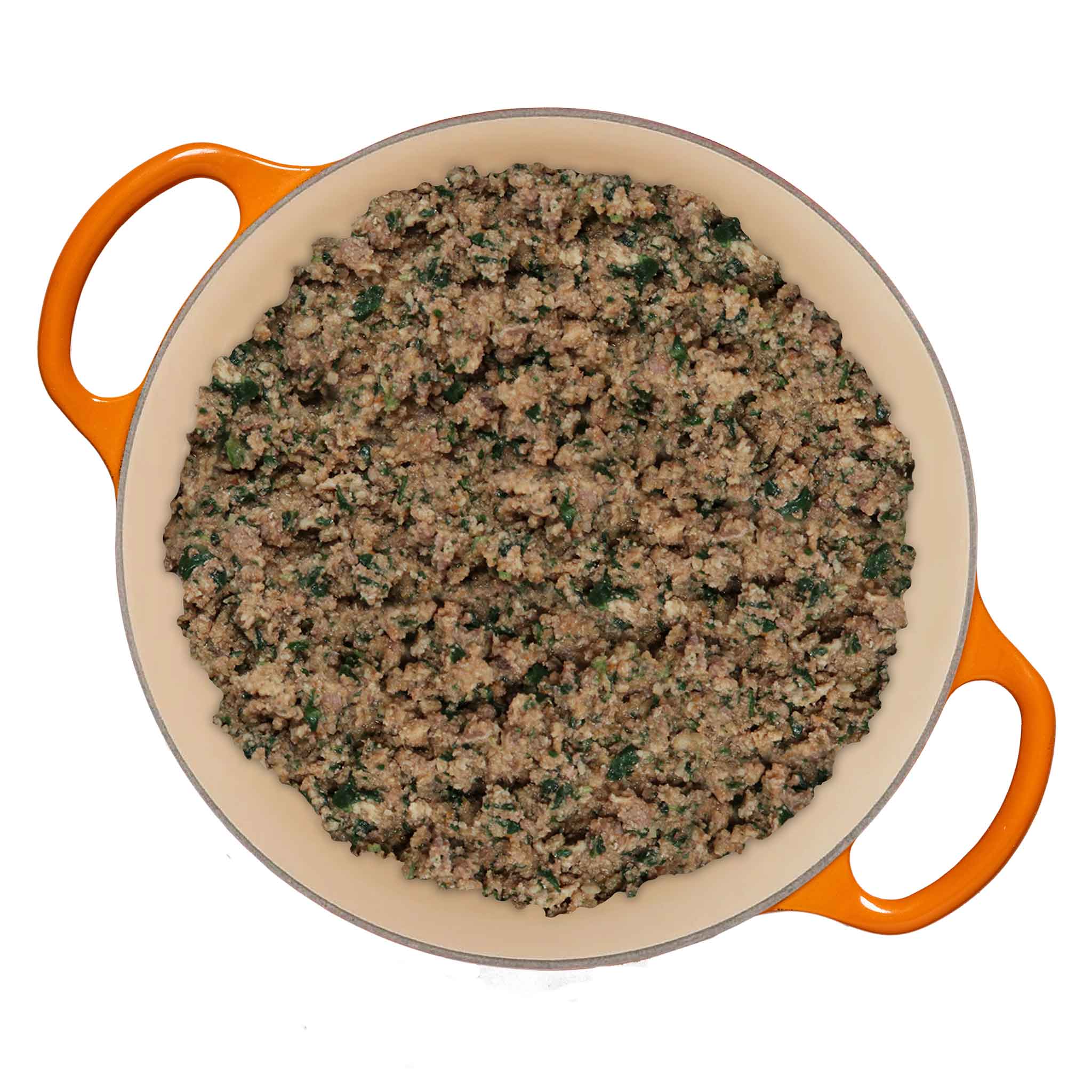
Because of the nature of gently-cooked, fresh food, moisture is largely retained from the ingredients themselves. All three Tom&Sawyer® cat recipes are over 75% moisture. Research in dogs has shown that fresh pet food can improve hydration and increase total water intake. 7
Maintaining optimal hydration supports many bodily functions, including the digestion of food. 8 A high-moisture diet can support the breakdown and absorption of food, and by potentially softening stools or increasing fecal moisture, it may help facilitate the passage of ingested fur, reducing the occurrence of hairballs. 9,10
Cat Vomiting Hairballs: What to Track and When to See Your Vet
Hairballs are considered a form of vomiting, and any vomiting in cats should be discussed with your veterinarian. They are not something to dismiss, especially when frequency increases.
If your cat is vomiting hairballs, here are some helpful steps to take before your vet visit:
Track how often it happens
Look for patterns in timing, behaviour, or environment
Note your cat's food type and daily intake
Having this information ready for your veterinary team can help speed up both diagnosis and treatment. The sooner patterns are identified, the faster the right course of action can be taken.
Tom&Sawyer®: Whole Food Nutrition for Your Feline Fur-iend
At Tom&Sawyer®, we believe your kitty deserves more than a meal. Our gently-cooked cat recipes are made with whole food ingredients, prepared in a federally inspected Human Grade facility, and formulated to support happier, healthier, longer lives™.
Every recipe includes our proprietary EHS™ Blend with chia seeds and FOS, whole food vegetables for added fiber, and over 75% moisture to support daily hydration. Because when you feed your feline fur-iend like family, they thrive like one.
Curious whether Tom&Sawyer® is the right fit for your cat? Reach out to our nutrition team at nutrition@tomandsawyer.com and we're here to help.
*Cat meals are currently available in Canada only.
References
Hoffman LA, Tetrick MA. Added dietary fiber reduces feline hairball frequency. Journal of Veterinary Internal Medicine 2003; 17: 431.
Hairballs. https://catfriendly.com/routine-care-grooming/hairballs/
Cannon M. Hair balls in cats: a normal nuisance or a sign that something is wrong? J Feline Med Surg. 2013 Jan;15(1):21-9. doi: 10.1177/1098612X12470342. PMID: 23254238. https://pubmed.ncbi.nlm.nih.gov/23254238/
Hand MS, Thatcher CD, Remillard RL, Roudebush P, Novotny BJ (Eds.). (2010). Small Animal Clinical Nutrition (5th ed.). Mark Morris Institute.
Donadelli RA, Aldrich CG. The effects of diets varying in fibre sources on nutrient utilization, stool quality and hairball management in cats. J Anim Physiol Anim Nutr (Berl). 2020 Mar;104(2):715-724. doi: 10.1111/jpn.13289. PMID: 31880029. https://pmc.ncbi.nlm.nih.gov/articles/PMC7079073/
Weber M, Sams L, Feugier A, Michel S, Biourge V. Influence of the dietary fibre levels on faecal hair excretion after 14 days in short and long-haired domestic cats. Vet Med Sci. 2015 Jul 7;1(1):30-37. doi: 10.1002/vms3.6. PMID: 29067172. https://pmc.ncbi.nlm.nih.gov/articles/PMC5645811/
Sires Rae, Yamka Ryan, Wakshlag Joe. Feeding fresh food and providing water ad libitum is clinically proven to exceed calculated daily water requirements and impact urine relative supersaturation in dogs. Frontiers in Veterinary Science. Volume 12, 2025. https://www.frontiersin.org/journals/veterinary-science/articles/10.3389/fvets.2021.675990