
Raw vs Kibble vs Gently Cooked Pet Food: Which Diet Is Right for Your Dog or Cat?
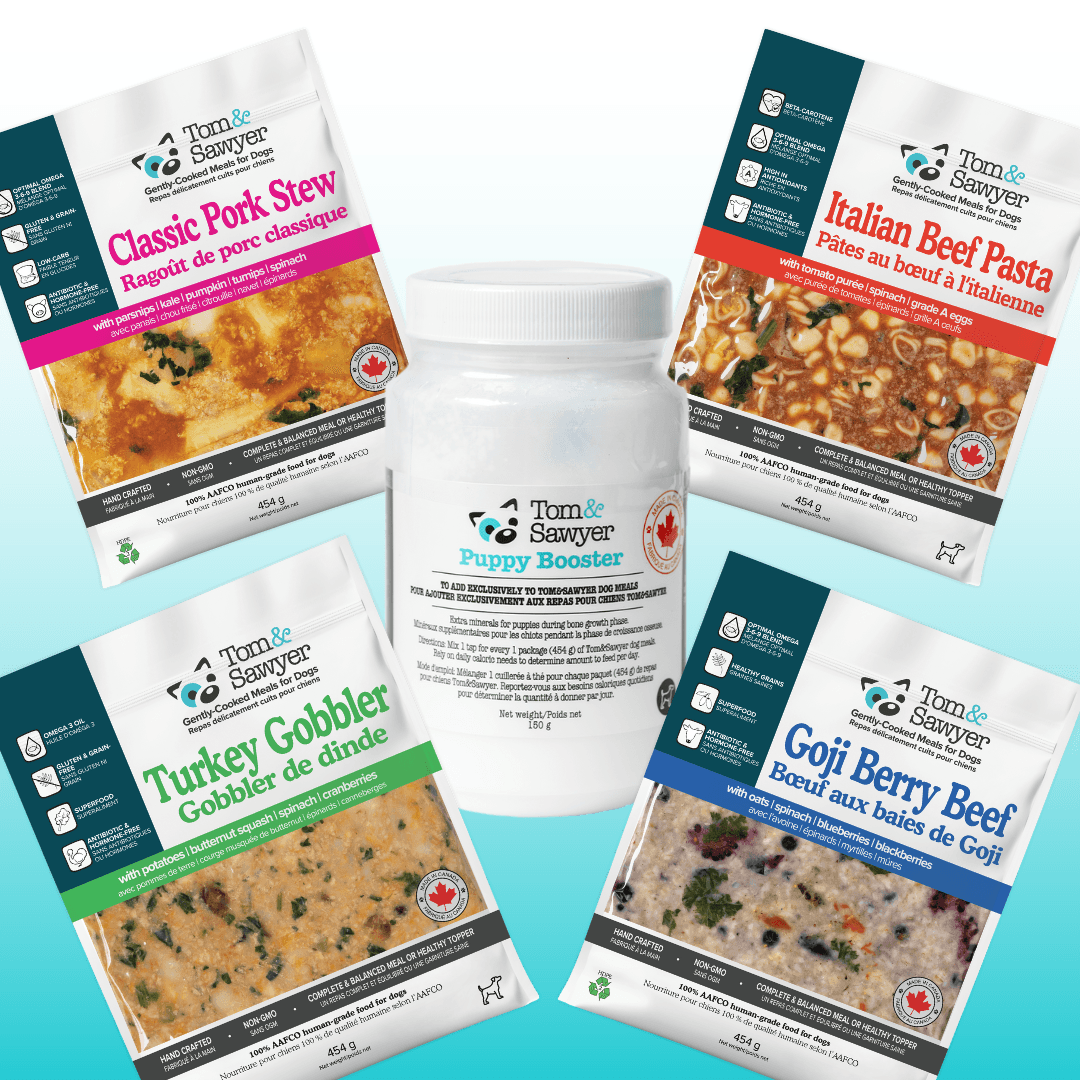
Search raw vs kibble vs gently cooked dog food and you'll find strong opinions in every direction. The honest answer: the right diet is a complete and balanced one that your pet does well on, that you can store and serve safely, and that fits your household. Each of the three main types of dog food gets there differently. As makers of gently-cooked meals for dogs and cats, we'll show you where each one shines and what to check, without the food fight.
What are the main types of dog food?
The main types of dog food are raw, dry (kibble) and gently-cooked fresh food, plus canned food, which we don't cover here. They differ mostly in how the ingredients are processed, which changes food safety, moisture, storage and cost.
- Raw: uncooked meat, organs and often bone, sold frozen or freeze-dried, or made at home.
- Kibble: dry food made by extrusion, a high-heat, high-pressure cooking process that makes shelf-stable pieces.
- Gently-cooked: whole ingredients cooked at lower temperatures to a safe internal temperature, then refrigerated or frozen.
Any of the three can be complete and balanced, or not. Check the nutritional adequacy statement on the label (AAFCO in North America) whatever type you choose. If you'd rather skip the label reading, take the meal quiz and we'll suggest meals for your pet.
Raw vs kibble vs gently cooked dog food: how do they compare?
This dog food diet comparison sets the three side by side on the points that matter day to day:
Raw | Kibble | Gently-cooked | |
Processing | Not cooked | Extruded at high heat and pressure | Cooked at lower temperatures to a safe internal temperature |
Pathogen control | Relies on safe handling | Cooking step | Cooking step |
Moisture | High | Low | High (73–80% max in our meals) |
Storage | Frozen; thaw in fridge | Shelf-stable in a sealed bag | Frozen; thaw in fridge |
Convenience | Strict hygiene at every meal | Easiest to store and serve | Thaw, portion, serve |
Cost per day | Usually higher | Usually lowest | Usually higher |
What to check | Complete and balanced statement, safety steps | Complete and balanced statement, named proteins, ingredient grade | Complete and balanced statement, ingredient grade, who formulates it |
Takeaway: the cooking step is what separates raw from the other two on safety, and ingredient quality and processing heat separate the cooked options from each other.
Raw vs kibble dog food: what's the real difference?
The real difference between raw and kibble dog food is the cooking step, and it shows most in food safety. In a two-year study, the FDA's Center for Veterinary Medicine screened over 1,000 pet food samples for bacteria. Of 196 raw pet food samples, 15 tested positive for Salmonella and 32 for Listeria monocytogenes; of 120 dry dog food samples, none did.1
That finding is about safe handling, and it affects people too: the FDA notes that owners who feed a raw diet may have a higher risk of getting infected with Salmonella and Listeria monocytogenes.1 If you feed raw, the FDA recommends washing your hands with soap and water for at least 20 seconds after handling it, and cleaning and disinfecting every surface and bowl it touches.1
Kibble's strengths are real: it's convenient, shelf-stable and affordable, and many dogs thrive on complete and balanced dry recipes. Where kibble varies is ingredient grade (feed grade versus human grade), protein sources (named meat versus meals and by-products) and processing heat. Grains are another difference between recipes, covered in our guide to grain-free vs grain-inclusive dog food.
Raw vs gently cooked dog food: is cooking a trade-off?
Gently cooking is a trade-off raw feeders often worry about, but cooking at moderate temperatures keeps most of what people like about raw while adding a safety step. Both use whole, recognizable ingredients with high moisture. The difference is that gently-cooked food is heated to an internal temperature that kills bacteria and pathogens.
At Tom&Sawyer, each ingredient is cooked individually to its optimal internal temperature: enough to make it safe, not so much that the nutrients are cooked out. And cooked food digests well. A peer-reviewed study of dog foods made with human grade ingredients found that, for the majority of essential amino acids, digestibilities were greater than 85%, with some greater than 90%.2
Thinking of combining them? Our article on mixing raw and gently-cooked food in the same bowl covers the safety and digestion questions.
Gently cooked vs kibble: what changes in the bowl?
The biggest changes from kibble to gently-cooked food are moisture, processing heat and ingredient grade. Our gently-cooked meals list 73–80% maximum moisture, so a bowl looks bigger and adds water to your pet's day.
Researchers have also compared the two directly. In a University of Illinois study of 12 beagles, dogs fed an extruded diet had to eat more to maintain their body weight and produced 1.5 to 2.9 times as much stool as dogs fed fresh diets.3 It's a small, industry-funded study of specific products, so treat it as one data point, not a verdict on every bag.
What we can speak to is our own standard: 100% human grade ingredients, prepared in an inspected human food facility in small batches, with no more than 3% of each recipe from added vitamins and minerals. Read more in why gently-cooked food is good for your dog.
What about cats? Types of cat food compared
The types of cat food mirror the dog options (raw, dry and gently-cooked, plus canned wet food), but two points weigh more heavily for cats: animal protein and water. Cats need taurine, an amino acid found only in foods of animal origin,4 and many cats don't drink much on their own, so moisture-rich meals help with hydration.
Gently cooked cat food covers both: high moisture and real animal protein, with the cooking step for safety. Our cat meals include Chicken Cacciatore for adult cats and two All Life Stages recipes, Bento Box and Wild West Kangaroo, that also suit kittens.
The raw vs cooked pet food question applies to cats too: the FDA's handling advice is the same whatever the species.1
How do you choose the right diet for your dog or cat?
Choose a diet that is complete and balanced for your pet's life stage, suits their health, and fits how you can store and serve food safely. Ask yourself:
- Does the label say complete and balanced for my pet's life stage?
- Does my pet have a health condition? Talk to your veterinarian first, especially for kidney, pancreatic or digestive issues.
- Is anyone at home immunocompromised, very young or elderly? Raw handling risks matter more.
- Do I have freezer space and a routine for thawing?
- What's my budget per day? Fresh food can also be used as a topper alongside your pet's current food.
Mixing types is fine too. Whatever you choose, switch gradually over about a week.
Ready to try gently-cooked meals with Tom&Sawyer?
If gently-cooked food fits your pet and your household, Tom&Sawyer makes it simple: human grade meals, formulated by animal nutritionists to meet AAFCO nutrient profiles, portioned to your pet and delivered on your schedule. See our standards for how we make every recipe.
Build your pet's Meal Plan in a few questions and join the pack of Sawyer's Loyal Companions. Because when you feed them like family, they thrive like one.
Please consult your veterinarian before making changes to your pet's diet, especially if your pet has a medical condition.
Resources
- U.S. Food and Drug Administration. "Get the Facts! Raw Pet Food Diets can be Dangerous to You and Your Pet." Content current as of February 22, 2018. https://www.fda.gov/animal-veterinary/animal-health-literacy/get-facts-raw-pet-food-diets-can-be-dangerous-you-and-your-pet
- Oba, P. M., Utterback, P. L., Parsons, C. M., & Swanson, K. S. (2020). True nutrient and amino acid digestibility of dog foods made with human-grade ingredients using the precision-fed cecectomized rooster assay. Translational Animal Science, 4(1), 442–451. https://doi.org/10.1093/tas/txz175
- Do, S., Phungviwatnikul, T., de Godoy, M. R. C., & Swanson, K. S. (2021). Nutrient digestibility and fecal characteristics, microbiota, and metabolites in dogs fed human-grade foods. Journal of Animal Science. https://doi.org/10.1093/jas/skab028 (University of Illinois summary: https://aces.illinois.edu/news/feed-fido-fresh-human-grade-dog-food-scoop-less-poop)
- ASPCA. "Cat Nutrition Tips." https://www.aspca.org/pet-care/cat-care/cat-nutrition-tips