
What Dog Food Digestibility Really Means for Your Dog
By Kelly Gredner, RVT, VTS (Nutrition) ·

Written by Kelly Gredner, RVT, VTS (Nutrition)
Dog food digestibility is one of the most important, and most overlooked, factors in your dog's overall health. For pet parents, understanding the distinction between digestion and digestibility is essential for further understanding the importance of canine nutrition. But, it isn't commonplace knowledge.
While digestion describes the physical and chemical breakdown of food, digestibility measures how much of that food is actually absorbed and utilized by the body.
As pet parents, the nutritional choices we make directly impact our dogs' digestive health, ensuring they receive the necessary nutrients for optimal health and long-term well-being.
The proof is in the poop!
How Canine Digestion Actually Works
The gastrointestinal system is responsible for digestion. It includes all of the organs that contribute to digestion, starting with the mouth and ending with the anus. Everything in between such as the esophagus, stomach, small and large intestine, the liver, gall bladder and pancreas are all part of this system.
Mouth - Saliva and chewing mechanically and chemically starts to break down food into smaller particles
Esophagus - The contractions (peristalsis) of the smooth muscles bring the food to the stomach
Stomach - Digestive enzymes and a highly acidic environment further breakdown the swallowed food preparing it for absorption
Small Intestine - Absorption of proteins (amino acids), fats, and carbohydrates happens here through the numerous villi and microvilli (finger like projections that line the small intestine increasing the surface area for nutrient absorption)
Liver - Aids in the metabolism of proteins, fats, and carbohydrates
Gall Bladder - Secretes bile to aid in fat digestion
Pancreas - Produces insulin to stabilize blood sugar levels, aid in fat digestion, and secretes bicarbonate to alkalize the broken down food to make it safe for travel through the intestines
Large Intestine (colon) - Reabsorption of moisture/water from the undigested waste material which is now called feces.
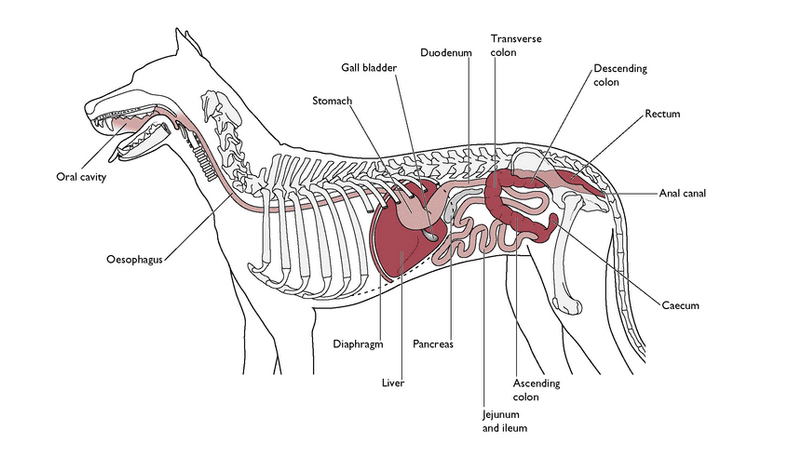
( diagram source )
This means that as soon as the dog starts chewing, the digestion process begins, and it ends when the waste is expelled (poop)!
The amount of time for food to move through the gastrointestinal system for dogs varies between 6 hours all the way up to 24-48 hours.
What Affects Dog Food Digestibility
It varies because digestion is a process that is impacted by many factors, such as:
Fat levels: Higher fat content can delay gastric emptying (the amount of time for food to move out of the stomach and into the small intestine).
Fiber content: It largely depends on the amount and type of fiber, but ultimately, most fibers will increase the amount of time it takes for food to move through the system.
Digestibility of the food: Highly digestible food can move through the digestive tract faster than less digestible food.
Size of the meal: Large meals affect the amount of time the stomach needs to emptying its contents into the small intestine
Activity levels of the dog: Exercise will stimulate peristalsis which can speed up the movement of food through the digestive tract.
Hydration & moisture content of the food: Proper hydration can improve saliva production, as a lubricant for food through the digestive tract, and help with nutrient transport once absorbed. Alternatively, dehydration reduces blood flow to the gastrointestinal tract.
Age: Senior dogs may exhibit slower or more difficult digestive capacity and metabolism compared to younger dogs.
Breed/size: The breed and size of your dog can affect the length of the digestive tract and also can result in changes in metabolism.
Diseases : Gastrointestinal disease states can affect gut transit time and the ability to breakdown and absorb nutrients.
NOTE: A healthy body makes digestive enzymes that are meant to break down food. Unless a dog has a medical condition like Exocrine Pancreatic Insufficiency (EPI), they do not need supplemental or added sources of digestive enzymes.
Digestion vs Digestibility in Dogs
What's the Difference Between Digestion and Digestibility
When it comes to digestion, terms like "easy/hard to digest" or "makes the body work harder" are commonly used. These may be marketing terms but what they are actually referring to is digestion and/or digestibility.
Digestion: A combination of mechanical and chemical processes that breakdown food into smaller, easily absorbable components. Digestibility : The percentage of nutrients that can be broken down into absorbable molecules in the digestive tract
A food or ingredient with low digestibility means less nutrients are absorbed to be utilized by the body and therefore more waste is produced (bigger poops)!
A food or ingredient with high digestibility means more nutrients are absorbed to be utilized by the body with less waste produced (smaller poops)!
Digestibility is also impacted by multiple factors like:
Food form (cooked, raw, purified)
Food type (fat, protein, carbohydrates)
Fiber quantity and type (soluble, insoluble)
Processing methods (low heat, high heat, steamed, boiled, uncooked, etc)
What Low and High Digestibility Look Like in Your Dog's Poop
Dog poop and diet are more connected than most people realize, and it starts with digestibility.
As pet parents, we control what food goes into our dog's body and are responsible for disposing of the waste afterwards. What happens between them is up to the dog!
Signs of a diet either being highly digestible, or low in digestibility, look very differently, and for a pet parent, these should be on your radar.
Feature
Low Digestibility
High Digestibility
Stool Quality
Larger, more voluminous; soft, messy, hard to pick up; straining to poop
Firm, log shaped, easy to pick up; easy to expel
Flatulence & Bloating
Flatulence; abdominal bloating/cramping
Lack of flatulence
Coat & Skin
Dry, brittle coat; dry, flaky skin
Lustrous, shiny coat; smooth skin
Energy & Appetite
Decreased energy; increased appetite
Good energy; moderated appetite
Nutrient Risk
Risk of nutrient deficiency
Minimal risk of nutrient deficiency
Can Dogs Digest Carbohydrates
Highly digestible dog food doesn't mean carbohydrate-free, and dogs can actually digest and utilize cooked carbs quite well.
Although dogs do not have a nutritional requirement for carbohydrates, they can, in fact, digest and utilize them. The important thing is that they need to be cooked to gain the benefits as cooking increases their digestibility. Carbohydrate sources commonly used in dog food are rice, oats, wheat, potatoes, etc.
Dogs have limited amounts of salivary amylase, so the digestion process truly starts in the small intestine. It has been shown that diets that contain between 35 – 40% starch on a dry matter basis are greater than 95% digestible¹,³.
There currently isn't evidence to suggest that there is harm to feeding a dog cooked carbohydrates as part of a healthy diet. Carbs are not the enemy! But a diet with low digestibility might be.
How the Gut Microbiome in Dogs Affects Digestibility
The gut microbiome plays a bigger role in dog food digestibility than most pet parents realize.
Carbohydrates, vegetables, and fruit provide fiber which gets fermented in the large intestine to produce short chain fatty acids (SCFA) which can then act as fuel for the gut bacteria living in the colon. This can increase the diversity of bacteria, increase bacterial activity, and contribute to normal bowel function². This also improves the health of the gut cells lining the intestine!
Conversely, a lack of fiber or diets high in animal protein can increase the amount of negative bacteria (pathogenic), protein by-products like ammonia, affecting the overall balance and reducing the amount of beneficial short chain fatty acids (the food for good bacteria)².
How a Fresh, Gently-Cooked Diet Improves Dog Food Digestibility
Fresh dog food digestibility tends to outperform more heavily processed options, and the research backs this up.
A fresh, gently-cooked diet with varying amounts of animal protein, fats, and carbohydrates is a great way to improve your dog's digestion. Human Grade, fresh diets are⁴,⁵:
Highly digestible
Reduce stool volume
Maintain healthy stools
Maintain a healthy body weight
Reduce bowel movement frequency
Improve vitality
Affect the microbiome diversity
Consider adding Tom&Sawyer® Human Grade, gently-cooked meals to your dog's bowl and see the benefits fresh food can make!
When it comes to dog food digestibility, small changes in ingredients and preparation can make a big difference, in the bowl, and in the yard.
Resources:
Rankovic, MSc, PhD, Dr. A. (2025, August 13). Carbs & Dogs. Pet Nutrition at OVC. https://ovcpetnutrition.uoguelph.ca/2022/11/17/carbs-dogs/
Clark, S. D., Hsu, C., McCauley, S. R., de Godoy, M. R., He, F., Streeter, R. M., Taylor, E. G., & Quest, B. W. (2023). The impact of protein source and grain inclusion on digestibility, fecal metabolites, and fecal microbiome in adult canines. Journal of Animal Science , 101 . https://doi.org/10.1093/jas/skad268
Isabella Corsato Alvarenga, Charles Gregory Aldrich, Yong-Cheng Shi, Factors affecting digestibility of starches and their implications on adult dog health, Animal Feed Science and Technology, Volume 282, 2021, 115134, ISSN 0377-8401, https://doi.org/10.1016/j.anifeedsci.2021.115134 .
Sungho Do, Thunyaporn Phungviwatnikul, Maria R C de Godoy, Kelly S Swanson, Nutrient digestibility and fecal characteristics, microbiota, and metabolites in dogs fed human-grade foods, Journal of Animal Science , Volume 99, Issue 2, February 2021, skab028, https://doi.org/10.1093/jas/skab028